Showing posts with label Birds. Show all posts

Sunday, April 16, 2017

April Birds and Creatures in Carcassonne

Because it's almost Easter, a European Rabbit, eating a poppy petal beside Carcassonne's Cité, or walled castle town.

European Rabbit.Carassonne. Copyright © Shelley Banks, all rights reserved.
We saw this quite small rabbit along the edge
of the castle walls. Here, it's eating a poppy petal. 
© SB
As for the birds, Pigeons are the most abundant species of birds I've seen in Carcassonne, roosting in nooks and crannies of the old castle walls.

Pigeons.Carassonne. Copyright © Shelley Banks, all rights reserved.
Pigeons. Carcassonne. © SB
Pigeons.Carassonne. Copyright © Shelley Banks, all rights reserved.
Pigeons everywhere. Carcassonee. © SB
Next, the Great Tit, whose loud song can be heard along the River Aude, below the walled city. (I'm glad these birds are now posing more cooperatively for me here, than in Paris.) 

Great Tit.Carassonne. Copyright © Shelley Banks, all rights reserved.
Great Tit singing beside the river, at Carcassonne. © SB
Great Tit.Carassonne. Copyright © Shelley Banks, all rights reserved.
Great Tit - Carcassonne. © SB
There are also many flocks of sparrows. The ones below appear to be Eurasian Tree Sparrows, with their characteristic brown heads and black cheek spots. (In this species, males and females look the same.)

Eurasian Tree Sparrows. Carassonne. Copyright © Shelley Banks, all rights reserved.
Eurasion, or European, Tree Sparrows. Carcassonne. © SB
And, here is a pair of common House Sparrows:

House Sparrow. Carassonne. Copyright © Shelley Banks, all rights reserved.
House sparrow - male. © SB
House Sparrow. Carassonne. Copyright © Shelley Banks, all rights reserved.
House Sparrow - female. © SB
Along the river, there were mainly Mallard ducks, though we saw a bright white duck that may have been a domestic breed, or -- from its curled tail feathers -- related to the Mallards...

Mallard. Duck.,Carassonne. Copyright © Shelley Banks, all rights reserved.
Mallard duck - male. © SB
Duck. White Duck,Carassonne. Copyright © Shelley Banks, all rights reserved.
Mystery duck - who really knows? © SB
And what would any water, much less the River Aude, be without a Herring Gull?

Herring Gull.Carassonne. Copyright © Shelley Banks, all rights reserved.
There are other similar gulls, but my guess is a Herring Gull. © SB
Or a European Beaver? This large rodent looks like our North American beaver, though with a paler coat and narrower tail, but it is a completely different species, once hunted almost to extinction.

European Beaver, Carassonne. Copyright © Shelley Banks, all rights reserved.
European Beaver, in the Aude River. © SB
European Beaver, Carassonne. Copyright © Shelley Banks, all rights reserved.
European Beaver © SB
We walked through the old graveyard beside La Cité de Carcassonne, the old walled town, and saw a Greenfinch. 

Greenfinch.Carassonne. Copyright © Shelley Banks, all rights reserved.
Greenfinch. That flash of yellow on the edge of its wings
is typical. 
© SB
Greenfinch.Carassonne. Copyright © Shelley Banks, all rights reserved.
Greenfinch, from another angle.. © SB 
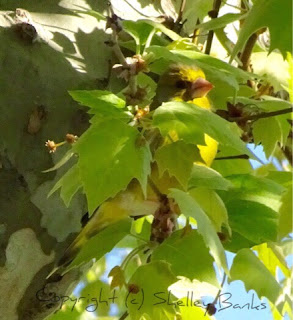
This bird below is also green, with a pinkish finch bill, and as that green belly colouring is typical, I think it's also a Greenfinch.
Greenfinch.Carassonne. Copyright © Shelley Banks, all rights reserved.
Greenfinch. © SB
The next bird was also in the cemetery. From its heavily streaked sides and yellow chest and head, it looks like a (European) Serin to me, one of the smallest of the finches. 

Serin.Carassonne. Copyright © Shelley Banks, all rights reserved.
European Serin, a small finch. © SB

Serin.Carassonne. Copyright © Shelley Banks, all rights reserved.
The Serin from another view. © SB
A break from the birds: in sunny spots, especially along the river through the lower town of Cacassonne, I found dozens of tiny brown lizards darting across the stones. 

Lizard..Carassonne. Copyright © Shelley Banks, all rights reserved.
I love these little lizards! © SB
Lizard..Carassonne. Copyright © Shelley Banks, all rights reserved.
Lizards like this were skittering over many sunny stones. © SB
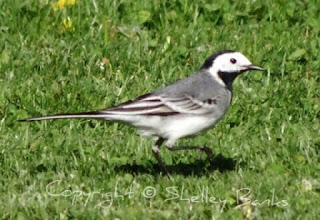
Some birds dart, too, like the White or Pied Wagtail, which I remember seeing in Ireland, too. 
Pied Wagtail.Carassonne. Copyright © Shelley Banks, all rights reserved.
Pied Wagtail. © SB
Walking through a park beside the river one morning, I found a European Robin. 

European Robin.. Carassonne. Copyright © Shelley Banks, all rights reserved.
European Robin. © SB
And, near the town laundromat, a European Goldfinch, collecting fibres for its nest. 

Goldfinch. Carassonne. Copyright © Shelley Banks, all rights reserved.
European Goldfinch, collecting nest materials.. © SB
Goldfinch. Carassonne. Copyright © Shelley Banks, all rights reserved.
European Goldfinch. © SB
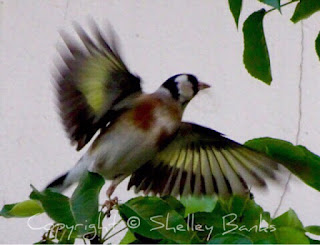
The bright yellow flash of a goldfinch's wings — that's the source of this bird's name.
Goldfinch. Carassonne. Copyright © Shelley Banks, all rights reserved.
Goldfinch in flight, showing the yellow on its wings. © SB
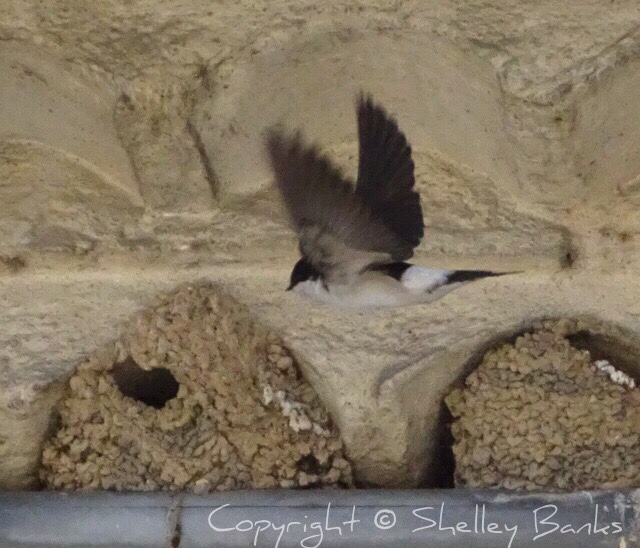
And black and white Common or House Martins have returned from their winter in Africa to their closed mud nests, tucked under the eaves and decorative cornices of many buildings here.

House Martins. Carassonne. Copyright © Shelley Banks, all rights reserved.
House Martins, nesting under the roof. © SB

House Martins. Carassonne. Copyright © Shelley Banks, all rights reserved.
House Martin, flying back to its mud nest. © SB
I've also seen and heard Starlings, and there are Jackdaws, too... And lots of new-to-me, unidentified birdsong...

###

Sunday, April 9, 2017

Birds in Paris in April

I doubt anyone comes to Paris to birdwatch, and if they do, they probably flee outside this dusty, noisy, well pruned city. Even in public parks (sand pathways, no undergrowth), we heard little birdsong, and saw few birds beyond the ever-present pigeons and starlings. 

But I kept listening, and looking, and in the end, our Paris list included Mallards, Mute Swans, Moorhens, those Chickadees relations the Blue Tits and Great Tits, Rose-ringed Parakeets, Wrens, a European Robin, a new-to-me little brown bird called a Dunnock, a species of Crow, and a Wood Pigeon. And many, many wild city pigeons, in varying hues.

(If we'd stayed longer, we'd have tried less urban parks...)

Rose-ringed Parakeet. Paris. Copyright  © Shelley Banks, all rights reserved.
Rose-ringed Parakeet, between the Louvre and
the Arc de Triomphe, along the 

Avenue des Champs-Elysees. © SB
European Starling. Paris. Copyright  © Shelley Banks, all rights reserved.
Starling, under the Tour Eiffel. © SB
(Winter) Wren. Paris. Copyright  © Shelley Banks, all rights reserved.
Winter Wren, in the Jardin des Plantes.  © SB 
European Robin. Paris. Copyright  © Shelley Banks, all rights reserved.
European Robin, in the Jardin des Plantes. © SB
Moorhen. Paris. Copyright  © Shelley Banks, all rights reserved.
Moorhen. Jardin des Plantes. © SB
Crow. Paris. Copyright  © Shelley Banks, all rights reserved.
 Crow. Jardin des Plantes.
(There are a few species of crows here; those
who know them will know better than me
which this one is!) 
© SB
Blue Tit. Paris. Copyright  © Shelley Banks, all rights reserved.
Blue Tit - Mésange bleue - near the Tour Eiffel. © SB
Blue Tit. Paris. Copyright  © Shelley Banks, all rights reserved.
Another view of the Chickadee-like Blue Tit
- 
Mésange bleue - near the Tour Eiffel. © SB

Great Tit. Paris. Copyright  © Shelley Banks, all rights reserved.
Great Tit - Mésange charbonnière -  along the 
Avenue des Champs-Elysees. This bird seems a bit larger
than its blue cousin, and has a strong black streak down
its chest. 
© SB
Great Tit. Paris. Copyright  © Shelley Banks, all rights reserved.
Another view of the Great Tit - Mésange charbonnière - 
along the 
Avenue des Champs-Elysees. © SB
Mute Swans.Paris. Copyright  © Shelley Banks, all rights reserved.
Mute Swans, along the Seine. © SB
Dunnock. Paris. Copyright  © Shelley Banks, all rights reserved.
Dunnock. A totally new to me little brown bird,
in colouring and movements, if not beak shape,
very like the North American native sparrows
that visit my yard in spring. Near the Tour Eiffel. 
© SB
Wood Pigeon. Paris. Copyright  © Shelley Banks, all rights reserved.
A Wood Pigeon, identifiable by the white neck flashes,
light yellowish eyes, and size -- larger than city pigeons. 

Near the Tour Eiffel. © SB
Pigeon. Paris. Copyright  © Shelley Banks, all rights reserved.
Ever-present city street pigeons of Paris. A wide variety
of colourings, all with orange-red eyes. Anywhere.
 © SB
Pigeon. Paris. Copyright  © Shelley Banks, all rights reserved.
Very pale white and black city pigeon. Everywhere. © SB
Pigeons. Paris. Copyright  © Shelley Banks, all rights reserved.
Yep. Very dark city pigeon. (There's only so much to say
about these birds...)
 © SB
Pigeons. Paris. Copyright  © Shelley Banks, all rights reserved.
Wood Pigeon, with several city street pigeons.  © SB

###

Wednesday, April 5, 2017

Rose-ringed Parakeets in Amsterdam

Wild parakeets were not on my list of expected sights in Amsterdam — but I can now recognize Rose-ringed Parakeets by flight pattern and sound even when they are high in the distance, or invisible in the canopy leaves.


Looks like a stuffed toy, doesn't it? But my hunch is that this exotic species, which descended from a few birds that escaped or were introduced decades ago, shares the collective spirit of its dinosaur ancestors.

That's based on its call, which reminded me of a horde of attacking pterodactyls in an old scary movie when we first heard it in the city's Vondelpark.

It's possible that native woodpeckers see them that same way, as they may compete for nesting space in holes in trees. (Tough to imagine a parakeet living in a tree, but we saw them creeping in.)


Amsterdam's Rose-ringed Parakeets are strangely beautiful, with their bright green feathers (the males also have a pink neck ruff), and long pointy wings and tails. 

But, well, seeing wild South Asian birds here feels just a little strange...

###


Tuesday, April 4, 2017

White Storks Nesting in Amsterdam

What a surprise to discover White Storks nesting in the city of Amsterdam. The pair in Vondelpark have been using a high secluded platform (roped off from the public) for several years, and there are other pairs in other city parks. 

White Stork, Amsterdam. Spring 2017. Copyright © Shelley Banks, all rights reserved.
White Stork, Amsterdam. Spring 2017. © SB
We also saw a single stork, perched on a tree trunk near the dogs' play area in Vondelpark, apparently unfazed by both dogs and passersby.

White Stork, Amsterdam. Spring 2017. Copyright © Shelley Banks, all rights reserved.
The pair of White Storks, on the nest.  © SB

These storks are very impressive birds — about four feet long, beak to tail, with wingspans up to seven feet. 

White Stork, Amsterdam. Spring 2017. Copyright © Shelley Banks, all rights reserved.
The wide wingspan of the White Storks.  © SB

I've read that birds returned to nesting in Amsterdam some years ago, after a gap of a few decades. Nesting platforms have been built to encourage males to settle and wait for the females, who arrive later from Africa each year.

One walker we met in the park said that each spring, it's a beautiful yet poignant sight, watching the male alone, building the nest, calling for the female, hoping she'll make the trip safely. 

Because of their size or wide distribution across Europe, legends have arisen about storks — including the story that they deliver babies, which has led to the stork becoming a symbol for midwives.

White Stork = the Midwife's sign, Amsterdam. Spring 2017. Copyright © Shelley Banks, all rights reserved.
Yes, there is a White Stork here -- a small model to the left
of the windows, the sign that this was the midwife's house.
Seen from the Amsterdam canal tour boat. 
 © SB
.
###