Showing posts with label Carcassonne. Show all posts

Sunday, April 16, 2017

April Birds and Creatures in Carcassonne

Because it's almost Easter, a European Rabbit, eating a poppy petal beside Carcassonne's Cité, or walled castle town.

European Rabbit.Carassonne. Copyright © Shelley Banks, all rights reserved.
We saw this quite small rabbit along the edge
of the castle walls. Here, it's eating a poppy petal. 
© SB
As for the birds, Pigeons are the most abundant species of birds I've seen in Carcassonne, roosting in nooks and crannies of the old castle walls.

Pigeons.Carassonne. Copyright © Shelley Banks, all rights reserved.
Pigeons. Carcassonne. © SB
Pigeons.Carassonne. Copyright © Shelley Banks, all rights reserved.
Pigeons everywhere. Carcassonee. © SB
Next, the Great Tit, whose loud song can be heard along the River Aude, below the walled city. (I'm glad these birds are now posing more cooperatively for me here, than in Paris.) 

Great Tit.Carassonne. Copyright © Shelley Banks, all rights reserved.
Great Tit singing beside the river, at Carcassonne. © SB
Great Tit.Carassonne. Copyright © Shelley Banks, all rights reserved.
Great Tit - Carcassonne. © SB
There are also many flocks of sparrows. The ones below appear to be Eurasian Tree Sparrows, with their characteristic brown heads and black cheek spots. (In this species, males and females look the same.)

Eurasian Tree Sparrows. Carassonne. Copyright © Shelley Banks, all rights reserved.
Eurasion, or European, Tree Sparrows. Carcassonne. © SB
And, here is a pair of common House Sparrows:

House Sparrow. Carassonne. Copyright © Shelley Banks, all rights reserved.
House sparrow - male. © SB
House Sparrow. Carassonne. Copyright © Shelley Banks, all rights reserved.
House Sparrow - female. © SB
Along the river, there were mainly Mallard ducks, though we saw a bright white duck that may have been a domestic breed, or -- from its curled tail feathers -- related to the Mallards...

Mallard. Duck.,Carassonne. Copyright © Shelley Banks, all rights reserved.
Mallard duck - male. © SB
Duck. White Duck,Carassonne. Copyright © Shelley Banks, all rights reserved.
Mystery duck - who really knows? © SB
And what would any water, much less the River Aude, be without a Herring Gull?

Herring Gull.Carassonne. Copyright © Shelley Banks, all rights reserved.
There are other similar gulls, but my guess is a Herring Gull. © SB
Or a European Beaver? This large rodent looks like our North American beaver, though with a paler coat and narrower tail, but it is a completely different species, once hunted almost to extinction.

European Beaver, Carassonne. Copyright © Shelley Banks, all rights reserved.
European Beaver, in the Aude River. © SB
European Beaver, Carassonne. Copyright © Shelley Banks, all rights reserved.
European Beaver © SB
We walked through the old graveyard beside La Cité de Carcassonne, the old walled town, and saw a Greenfinch. 

Greenfinch.Carassonne. Copyright © Shelley Banks, all rights reserved.
Greenfinch. That flash of yellow on the edge of its wings
is typical. 
© SB
Greenfinch.Carassonne. Copyright © Shelley Banks, all rights reserved.
Greenfinch, from another angle.. © SB 
This bird below is also green, with a pinkish finch bill, and as that green belly colouring is typical, I think it's also a Greenfinch.
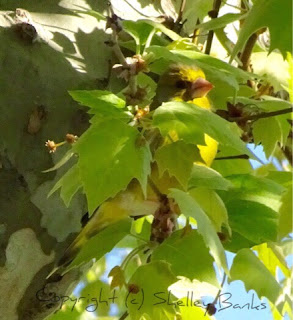
Greenfinch.Carassonne. Copyright © Shelley Banks, all rights reserved.
Greenfinch. © SB
The next bird was also in the cemetery. From its heavily streaked sides and yellow chest and head, it looks like a (European) Serin to me, one of the smallest of the finches. 

Serin.Carassonne. Copyright © Shelley Banks, all rights reserved.
European Serin, a small finch. © SB

Serin.Carassonne. Copyright © Shelley Banks, all rights reserved.
The Serin from another view. © SB
A break from the birds: in sunny spots, especially along the river through the lower town of Cacassonne, I found dozens of tiny brown lizards darting across the stones. 

Lizard..Carassonne. Copyright © Shelley Banks, all rights reserved.
I love these little lizards! © SB
Lizard..Carassonne. Copyright © Shelley Banks, all rights reserved.
Lizards like this were skittering over many sunny stones. © SB
Some birds dart, too, like the White or Pied Wagtail, which I remember seeing in Ireland, too. 
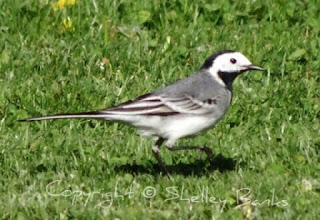
Pied Wagtail.Carassonne. Copyright © Shelley Banks, all rights reserved.
Pied Wagtail. © SB
Walking through a park beside the river one morning, I found a European Robin. 

European Robin.. Carassonne. Copyright © Shelley Banks, all rights reserved.
European Robin. © SB
And, near the town laundromat, a European Goldfinch, collecting fibres for its nest. 

Goldfinch. Carassonne. Copyright © Shelley Banks, all rights reserved.
European Goldfinch, collecting nest materials.. © SB
Goldfinch. Carassonne. Copyright © Shelley Banks, all rights reserved.
European Goldfinch. © SB
The bright yellow flash of a goldfinch's wings — that's the source of this bird's name.
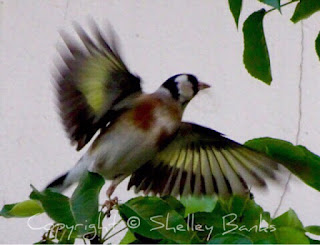
Goldfinch. Carassonne. Copyright © Shelley Banks, all rights reserved.
Goldfinch in flight, showing the yellow on its wings. © SB
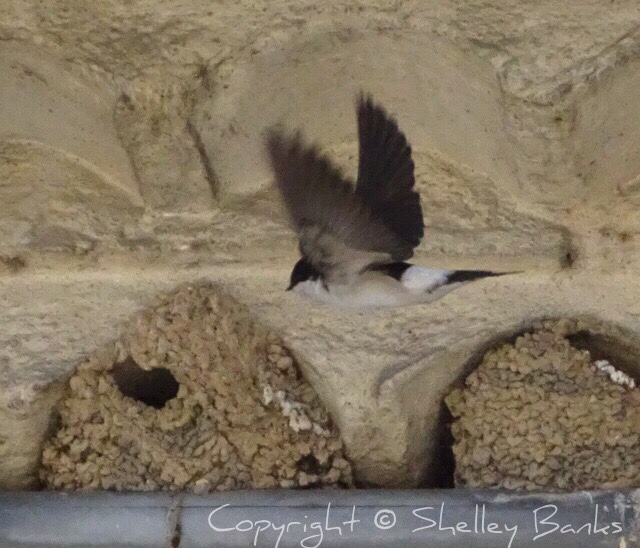
And black and white Common or House Martins have returned from their winter in Africa to their closed mud nests, tucked under the eaves and decorative cornices of many buildings here.

House Martins. Carassonne. Copyright © Shelley Banks, all rights reserved.
House Martins, nesting under the roof. © SB

House Martins. Carassonne. Copyright © Shelley Banks, all rights reserved.
House Martin, flying back to its mud nest. © SB
I've also seen and heard Starlings, and there are Jackdaws, too... And lots of new-to-me, unidentified birdsong...

###

Thursday, April 13, 2017

Last Day in Carcassonne

Shelley and I, having weathered a Saskatchewan winter with not so much as a sniffle picked up a nasty cold in Paris. That cut back on our activities in Carcassonne. No excursions to explore Cathar castles or the opportunity to sample the wine produced by the small vineyards in the Aude. WE laid low and are slowly coming back to the land of the living.


The Canal Pleasure Craft Follow the Traditional Canal Barge Look.
Shallow draft with a flat high prow.
Today we caught the local bus into the town below and explored a little bit of the Canal de Midi. Pretty amazing that someone, without the air of heavy equipment decided to build a canal connecting the Mediterranean with the Atlantic Ocean. These days it is mostly pleasure craft and rented house boats. Running from the city of Toulouse down to the Mediterranean port of Sète, the Canal du Midi is considered an extraordinary 17th century feat of engineering and has been a Unesco World Heritage Site since 1996.


The idea of building a waterway joining the Atlantic to the Med was voiced by the Romans and again by Charlemagne but it took one of Louis XIV's tax inspectors to make it come together.

We found the local market and sampled some local dried sausage and looked over the fresh vegetables. We will be so glad in a couple of stops when we can say goodbye to hotels and begin to cook our own meals, taking advantage of these markets.


Back at the Cite we wander a bit and were amazed to see with the clear visibility how the snow capped Pyrenees stood out against the sky. To top it off Shelley found a rabbit eating poppies in the grass beside the wall.


Hmmm Those red things look good


After an afternoon nap we decided an early supper was in order before we packed. We came across a neat small courtyard wine bar which was laid back and had the type of food we were looking for.
We has a bottle of Chateau Jouclary, a Cabardes. We really quite liked it.

Unique but it Can Be Crowded


There is no question about it. Carcassonne is an amazing place to visit and staying within the walls of the medieval city is a thrill.
But there is a down side.
Starting at about 8:00 in the morning tourists flock in. The walk up the hill in a steady flow, huffing and puffing but eager to experience this unique place.
The streets are packed, even in April. I can't imagine what it must be like in August.
There are very few places to stay within the wells. We booked very early and managed to get a room at the Hotel Le Dongon but there isn't much else. The down side to staying within the walls is that you are held hostage to the 15 Euro buffet breakfast simply because there is no option. The restaurants within the walls, and there are many of them, don't open much before lunch.
The One Table sits in the Point of the Triangular Space Allotted
Most open spaces have several restaurants competing for a place to put their tables outside in the sun. They are so cramped together and until you figure it out, it can be difficult to determine where one ends and another begins. You can easily read the posted menu, sit down only to find that you are actually seated in another restaurant altogether.
To help sort it out lines have been painted on the cobblestones staking out territories.
The Cite is full of places catering to kids, selling wooden swords, crossbows and fake metal helmets. Kids chase each other through the throngs brandishing swords. Shelley almost got shot by a crossbow wielding eight years old yesterday.
The crowds don't diminish until late then in the early morning lane sized street sweepers clean the cite up, the restaurants are replenished early before the throng returns and then everything opens and they do it all again

Wednesday, April 12, 2017

Drinking Wine in Carcassonne


It had been my plan to sample quite a bit of wine here in Carcassonne but we both came down with bad colds in Paris and it has restricted our consumption. Carcassonne is in the French Department of Aude. The region produces a lot of good wine.

Some we see in Saskatchewan, some not. This is not a complete list.


La Clape
I guess we can understand why this particular wine doesn’t seem to have been marketed in North America. Nevertheless, La Clape’s  red wines are produced from Grenache, Syrah and Mourvedre that they say combines both elegance and power. Situated less than four miles from the coast, the Mediterranean climate of long hot summers and relative mild winters provides the goodconditions for wine production.

Quatourze
A neighbour of La Clape, wedged between Narbonne to the North and the Etang de Bages lagoon to the south It is a small appellation that produces red wine from Grenache, Syrah and Mourvedre grapes.

Fitou
Fitou is a large red wine appellation situated North of Perpignan in Roussillon, France. The dominant vine variety is Carignan which constitutes 40% of any blend. Grenache, Llandoner Pelut, Mourvèdre and Syrah are also often blended with it. These wines are made for drinking young, and quite a bit of tannin. We had one the other night and quite liked it.

Minervois
This wine region is located within a triangle formed in-between Beziers, Carcassonne and Narbonne. The region is hilly and the soil is good. If you prefer full-bodied reds a Minervois from a high altitude vineyard is a good choice.

Saskatchewan used to carry one red but I think the stopped bringing it in. I quite like it.

Blanquette de Limoux
Limoux is best known for its sparkling wine, Blanquette de Limoux. This is reputed to be the oldest sparkling wine in France and dates back to 1531 when Benedictine monks from Saint Hilaire Abbey discovered that the wine they had laid down had fermented and formed bubbles. They claim that as a young monk Dom Perignon lived there for a while and that he stole the process and went on from that to create ‘Champagne‘.

Coteaux de Languedoc
The AOC Coteaux du Languedoc appellation has covers an area between Nimes and Narbonne and benefits from the sunny climate of the Herault, The rich soils produce a good grape, We are beginning to see the odd one in Saskatchewan stores.

Malpere
The Malepere appellation area is the most westerly of Languedoc wine regions. The wines are produced in an area situated south west of Carcassonne. They produce a mixture of different grape varieties are planted. They combine the strength, smoothness and depth of flavour of red fruits, spices, plus hints of soft vanilla. They say a perfect accompaniment to Cassoulet, red meats game or cheese.. The name looked to me like it could be translated as “Bad Father” but the Pere reference in the name actually refers to “Pierre” of stones or rocks and refers to the rocky soil in the area.

Corbieres
One of the most productive appellations in Languedoc-Roussillon, The Corbieres appellation covers a large area to the south and west of Narbonne. The vineyards turn out large quantities of red and rose wines along with a growing number of whites.   I wish we saw more of it.

Tuesday, April 11, 2017

The Universal Cassoulet Academy

So Good
The first time Shelley and I had cassoulet  was here in Carcassonne almost 30 years ago. It was wet. Pouring rain in fact. We wandered around the ramparts and despite our "waterproof" jackets we got quite soaked.

We met up with my brother and his wife later in the afternoon and shivering cold we retreated to a stone walled restaurant with a blazing fireplace, settled in and ordered a big bowl of cassoulet. It was exactly what we needed.

This evening we went next door to the Brasserie Le Dongon, all attempts to find the original restaurant from 30 years ago being unsucessful and tried it again. The Cassoulet Languedocien is a regional recipe and had duck and sausage in it. It came bubbling hot from the oven and was delicious.

I knew cooks in the South of France are pretty fussy about their cassoulet but we were surprised when we learned that they have established The Universal Cassoulet Academy so as to regulate how it is prepared and to make sure no pretenders corrupt the traditions of this classic recipe. (I know a restaurant in Montreal that should get a visit from these guys)

This is serious stuff.  When it comes to this meal their brochure says "Castelnaudary is the Father, Carcassonne the son, Toulouse the Holy Spirit. But they are all Cassoulets. Cassoulet is the God of Occitan culture."

What more can we say except to point out that they offer a recipe,

Give it a try.


How Did the Place Get Its Name - Or not.


The site of the UNESCO Heritage walled city has been occupied as some sort of fortification or another since the 5th century B.C. Throughout history, one group after another built fortifications on this strategic hill Overlooking the Pyrenees to the south and down the Aude Valley to the north and east. In years past the Spanish border closer than it is now and not not very far down the road. Even now it isn't much more that 100 km.

The first story I heard about how Carcassonne was named is probably not true at all but in keeping with the philosophy that one should never let the facts get in the way of a good story...here goes.

In the 8th century, there were wars between Christians and the Moors in the southwest of Europe. At that point in time, Carcassonne was under Moorish rule. As the story goes, Charlemagne's army was at the gates of the city and laid siege to it in an effort to take the city back for the French.

The ruler lead a small raiding party out to attack Charlemagne's troops. After all that is what leadership is all about, isn't it? Unfortunately, he was killed almost immediately..

Upon his death, his wife named Carcas assumed the the position as leader over what remained of the Knights of in City.

She manned the ramparts with what was left of her army, the elderly, children and built straw figures to make it seem they had a significant force within.The siege lasted for some extended period. As food and water were running out. Carcas made an inventory of all remaining reserves. Things were desperate. She ordered the villagers to round up a pig and a sack of wheat. She force fed the pig until couldn't eat nay more. She then threw it off the highest tower of the city walls. The pig burst when it landed.

Seeing that, Charlemagne is said to have felt it was useless to continue and lifted the siege, believing that the city had enough food to the point of wasting pigs fed with wheat.

Caracas
As Charlemagne's army broke the siege and moved off, Overjoyed by the success of her plan, Lady Carcas decided to sound all the bells in the city. One of Charlemagne's men is said to have exclaimed: "Carcas sonne!" (which means “Carcas sounds”). Hence the name of the city.

Carcas appears to be a fictional character however. The story dates back to oral traditions of the 12th
century and was written down in the 16th century. In fact, Charlemagne could not have besieged Carcassonne, as his father Pepin had already taken the city from the Saracens in 759 - Charlemagne would have only been 17 at the time.

Never the less at the Porte Narbonnaise by the drawbridge, a replica of her bust welcomes visitors. The original well weathered and dating from the 16th century is preserved in the castle.

Early morning Carcassonne

I was up earlyish to wander the city almost void of people on the streets except for delivery trucks servicing the hotels and restaurants first thing before many of the tourists hit the street and vehicles are banned.

It struck me as a B&W kind of day.


La Porte Narbonne


La Porte Aude From the Castle Walls

Leading to La Porte Aude
The reverse shot of the Photo Above


May The Force be With You


Monday, April 10, 2017

And on to Carassonne

We got a good start and caught the bus to the Gare de Lyon and headed inside to figure out yet another train system. We were doing fairly well when a SNCF guy arrived to help. He answered a few questions and congratulated Shelley on her French. He said he spoke a little English, kind of the equivalent to my French. I told him I spoke bar and restaurant French he agreed, and laughed.

There was ap problem with our train and a herd of us hung around the departure screens waiting for the track to be announced. They kept delaying until finally they announced track "E" and we were on our way. We had 1st class seats on the second level of a double decker TGV. (Train Grand Vitesse)

We pulled out of Paris 50 minutes late which meant out connection in Montpellier was not going to work.

We went from Paris in the north to Montpellier in the south in three and a half hours. I can report that the 1917 grape crop seems to be off to a good start, We saw so many vineyards.

Montpelier was confusing. We thought we would need new tickets but the train people just said, "Get on the train to Narbonne then grab the first train to Carcassonne from there." It turned out to be simple and we got to Carcassonne about an hour late which is pretty good considering the extra train connection and the late departure from Paris.

On the way the Mediterranean was to the south of us although we didn't see much of it but we could smell the salt air.  We past  Béziers where the brutal massacre against the Cathars took place.

We are staying at Le Dongon Hotel right within the walls. We were lucky enough to get upgraded to a larger room about twice the size of our Paris room. It even has a bath.

We are tired and not ready to spend a bundle on a big meal to we walked around for a while and stopped off at one of the sidewalk cafes for a glass of wine. The waiter promptly short changed me but was full of "Oh, Je suis désolé monsieur" We only stayed for the one glass.

Interesting that here the south of France, close to the Spanish border the way it is spoken is very much influenced by Catalan and Spanish. In other words, I have a hard time understanding them and they me.

We decided on a small Italian restaurant that had a walled garden in the back with wisteria growing up providing o cover. It was a beautifully warm night.


We had a Regina Pizza and a salade Magret de Canard.


The restaurant had a singer/guitarist who sang a song for each table. Mostly old classics. He caught Shelley's eye and sang "Besame Mucho" All very romantic.


We walked back through the narrow streets under a full moon. Very cool.